

In a seminar titled “From Classroom Practice to Evidence: Single-Case Research Design in Special Education,” Prof. Hua discussed how single-case research designs can help educators move beyond intuition and group averages to rigorously document the impact of their day-to-day teaching. Prof. Hua began by highlighting a central challenge in contemporary education: educators are increasingly accountable for demonstrating that their teaching truly helps individual students learn, not just raising class averages. To meet this challenge, assessment tools must be observable, measurable, sensitive to change, and able to provide timely feedback for instructional decision-making.
Against this backdrop, Prof. Hua presented single-case research design (SCRD) as a rigorous yet practical methodology. SCRD uses the individual student as the unit of analysis and relies on repeated, direct measurement of behavior or academic performance over time. Through visual analysis of data patterns—such as changes in level, trend, and variability—educators can judge whether an intervention is functionally related to observed improvements.
The seminar introduced several key SCRD formats, including ABAB (reversal) designs, multiple-baseline designs, and alternating-treatment designs. Prof. Hua illustrated these designs with concrete examples: improving reading fluency by tracking correct words per minute, increasing social interaction between students with autism and peers through contingency contracts, and comparing reading comprehension interventions with and without vocabulary instruction. These examples showed how educators can systematically test “can do” versus “won’t do” problems, refine intervention components, and determine when additional instruction or motivation is needed.
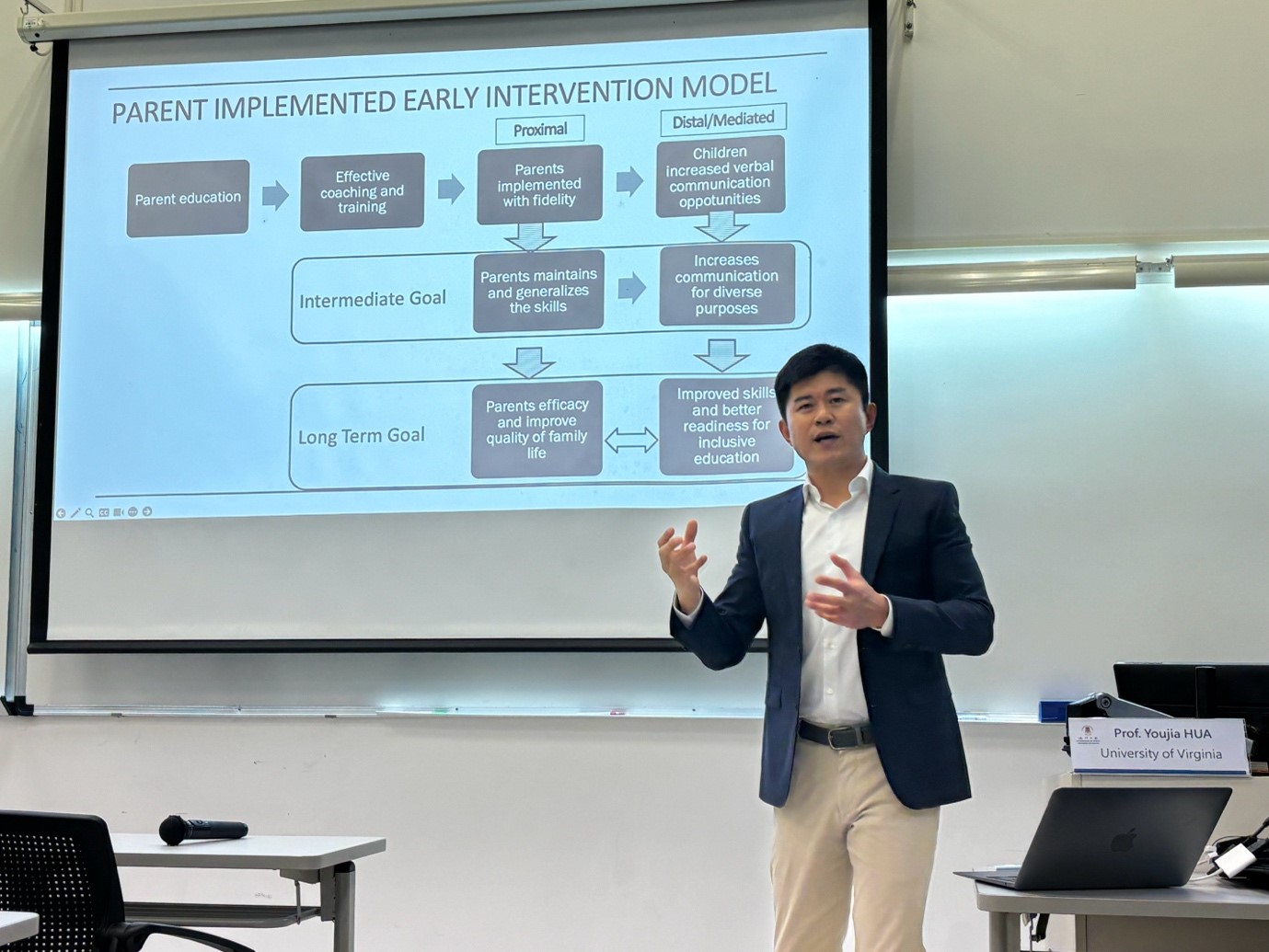
Prof. Hua also discussed newer developments, such as incorporating randomization into single-case designs to strengthen causal inference and reduce Type I and Type II errors. Finally, he emphasized the role of SCRD within multi-tiered systems of support (MTSS), from school-wide practices to intensive one-on-one interventions, and its potential to bridge research and practice by enabling teachers themselves to contribute rigorous, evidence-based knowledge about “what works” for their students.